


Moneo building
Space Cúbic
L'edifici Moneo, seu actual de la Miró Mallorca Fundació, es va inaugurar el 1992. Projectat per l'arquitecte Rafael Moneo és el resultat de la donació de Pilar Juncosa, vídua de Miró, a la Ciutat de Palma.
-
Exhibition space
- Space Cúbic
-
Dates
- 15 April — 6 September 2026
-
Inauguration
- 15 April 2026
- 19:00
Carlos Bunga. “New life after fire”
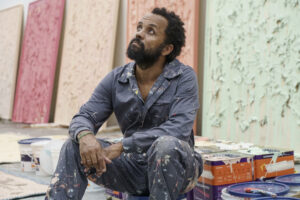
Carlos Bunga's work (Porto, Portugal, 1976) sits at the crossroads of disciplines such as architecture, painting, sculpture and performance, and between doing and undoing, the micro and the macro, the transcendental and the mundane.

“The land gives us so many gifts; fire is a way we can give back. In modern times, the public thinks fire is only destructive, but they’ve forgotten, or simply never knew, how people used fire as a creative force. The fire stick was like a paintbrush on the landscape. Touch it here in a small dab and you’ve made a green meadow for elk; a light scatter there burns off the brush so the oaks make more acorns. Stipple it under the canopy and it thins the stand to prevent catastrophic fire. Draw the firebrush along the creek and the next spring it’s a thick stand of yellow willows. A wash over the grassy meadow turns it blue with camas. To make blueberries, let the paint dry for a few years and repeat. Our people were given responsibility to use fire to make things beautiful and productive – it was our art and our science.”
Braiding Sweetgrass, by Robin Wall Kimmerer
Fire, both a destroyer and creator, is a symbol of transformation, regeneration and purification. Together with water, it is also the most feared element in the current climate crisis caused by the limitless greed of humans, exhausting nature for their own profit. Wildfires threaten forests and fields and everything human and more-than-human living in them. Its devastating power, especially when it teams up with the element wind, can leave hectare after hectare of earth charred and barren within no time, reducing hues of green, brown and rich floral colours to just greys and blacks. Amazingly, fire also has the power to rejuvenate a forest or a field, giving way to new life after the fire extinguishes. For centuries, fire has been applied in a controlled way by our ancestors in a reciprocal act of giving to and taking from nature, exchanging rampant overgrowth for plants that feed and heal, as well as providing useful materials, for instance to weave baskets. Fire also turned what was gathered and hunted by our forebears into cooked meals and transformed malleable earth (clay) into solid pots for the preparation of food and into protective vessels to store water and seeds.
Fire is also used for ritual purposes, as in the Yaqui communities’ Easter ceremonies and, closer to home, the celebration of Saint John’s Eve (Sant Joan in Catalan). Carlos Bunga once witnessed a Yaqui Easter ceremony in Arizona in which the demon masks, painstakingly handmade during the year leading up to the celebration, were burnt at the end of the ceremony, so that new ones had to be produced for the following year. This powerful experience and imagery took root in Bunga’s brain, like a seed that remains dormant under the ashes after a bushfire until its moment has come to sprout. If a seedling is nurtured and fed, it may come to fruition. And so it did for Bunga, informing his project for Miró Mallorca, whose exhibition period coincides with the celebration of the Feast Day of Saint John. Saint John’s Eve, on 23 June, aligns closely with the summer solstice, the year’s longest day and shortest night. For centuries, agricultural societies marked this moment with fire rituals to usher in summer, ensure bountiful harvests, promote fertility and ward off evil spirits. Fire was also believed to purify and bolster the sun’s strength.
We have to acknowledge, though, that fire the destroyer also has a place in this world. Nevertheless, it is Bunga’s belief that destruction (a word he avoids at all cost) never means the end of something but rather a new beginning. When Joan Miró’s World Trade Center Tapestry (1974) fell prey to the fire and rubble to which the ‘Twin Towers’ were reduced after the attacks of 9/11, it was the end of the tapestry. But 9/11 also marked the beginning of a new era, ushering us further into the complex and divided world we live in today, in which the reciprocal act of taking and giving of our ancestors has been replaced by the relentless corporate exhaustion (often with governmental backup) of whatever Mother Earth possesses that is of human (and the neglected more-than-human) interest. Not all transformations are for the better. [2]
Writing about an exhibition by Carlos Bunga months before it is held is like writing a review of the upcoming album from your favourite band without having heard anything about it except some faint rumours, let alone the music itself. Bunga’s projects are subjected to thorough research and preparations by the artist and the resulting exhibition, and any new works created for it, mostly come into being further on in the process, often quite soon before the opening. For his project at Miró Mallorca, Bunga is interested in weaving traditional everyday objects and crafts into his exhibition, like the objects Miró had lying around in his houses and studios, as well as reflecting Miró’s interest in the process and possibilities of crafts such as tapestry making. Having talked with Bunga about the powerful image and connotations of fire and its different uses and symbolic meanings, it seems clear to me that it will play an important role in the project. Exactly what this fire will transform, regenerate and purify is currently a mystery. However, knowing the artist and his work, there will surely be new life after the fire, so that visitors can explore a before, its transformation, and an after.
Roland Groenenboom
______________________________
[1] The title is adopted from the album New Life After Fire (for Tom Thomson) by Lee Ranaldo with Dave Dyment, which was released on 5 September 2001, less than a week before the World Trade Center attacks of 9/11.
[2] The tapestry was made of wool and hemp and measured 6.1 × 10.7 m, weighing 4 tonnes. Could it have been an omen that I see an unhappy frog-like face in the large form on the left of the tapestry?
Contact
Collections
Fundació Miró Mallorca
Carrer de Saridakis, 29
07015 Palma
Tel. +34 971 70 14 20
exposicions@miromallorca.com
Biography
Carlos Bunga (1976 Porto) studied at ESAD in Caldas da Rainha, Portugal, and lives in Barcelona. He often uses common materials such as cardboard, adhesive tape, and fabric to create his installations. Straddling the line between sculpture and painting, his seemingly delicate and fragile works highlight the performative aspect of the creative act.
His solo exhibitions include those at the Miami Art Museum (Miami, 2009); the Lisbon Architecture Triennale, 2010; the Hammer Museum (Los Angeles, 2011); Serralves Museum (Porto) and Pinacoteca of São Paulo (2012); MUAC (Mexico City, 2013); Haus Konstruktiv Museum (Zurich, 2015); Museo de Arte de la Universidad Nacional, Bogotá and the United States Architecture Biennial in Chicago, highlighting the intervention in the Capella dels Àngels at MACBA in 2026 and at the Palacio de Cristal in Madrid, of the MNCARS, in 2022.
©Flávio Freire
